Who was Luke Miller?
|
 |
|
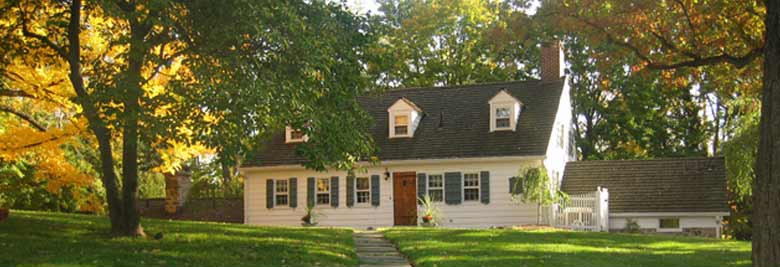
Luke Miller joined the militia at the age of seventeen and, according to original documents, “In the month of June, 1776 he turned out and went into service as a volunteer when the British troops landed at Staten Island. He joined a company then commanded by Lieutenant Hand.” Luke fought in several important battles including the battles of Springfield and Short Hills; he achieved the rank of Major in 1778, at the age of nineteen. When he returned to his home and farm, Luke continued with the family’s blacksmith trade as his father Josiah Miller had before him. Luke’s son, John B. Miller, followed him in the trade, and John’s son, David L. Miller, adopted the blacksmith trade as well. According to the book Bottle Hill and Madison, by William Parkhurst Tuttle, printed Madison Eagle Press, Madison, NJ, (1917), “Major Luke Miller was born at the house, known as Miller’s Station, in 1759 and resided there until his death at age 91, in 1851. Luke married three times and fathered eleven children. During the Revolutionary War era, while the Continental Army was encamped [following battles fought in Trenton and Princeton] in Loantaka Valley [one and a half mile southeast of Morristown, bordering on the western side of the Borough of Madison], and Jockey Hollow, [Morristown] the home was the site of much hospitality to war-weary officers. General George Washington is reported to have been a frequent guest at the home” (from the books Bottle Hill and Madison, by William Parkhurst Tuttle and The Madison Heritage Trail, by Frank J. Esposito, (1985). Certainly, while the General and his officers stayed at the main house, their horses were attended to and the Forge was used to shoe the animals, repair wagon wheels, and fix or make hand tools, such as hammers and axes, needed by the men back at the camps in Loantaka Valley and Jockey Hollow. A second reference in the September 14, 1901 issue of the Newark Evening News reports that “In the front room on the northeast of the building, [Miller’s Station] Washington wrote several letters while in another wing of the building he discussed the war situation with his brother officers.” The Millers, as was common practice in all trades, took on apprentices. According to the September 14, 1901 issue of the Newark Evening News apprentice Charles C. Force learned the blacksmith trade from Iron Master Miller “. . . who had a forge in an old building adjoining the homestead property.” Charles Force served as an apprentice for eight years. After learning the trade Charles established his own blacksmith shop known as the ‘Madison Iron Works’, serving the community in much the same way that Iron Masters Josiah, Luke, John, and David did. The Miller Forge was also important in the early economy of Morris County since travelers would have their horses shod, coach wheels repaired, and tools made or repaired, resulting in prospective trade for area merchants. The Luke Miller House and surrounding property, located at 105 Ridgedale Ave., Madison, remained in the Miller family until it was sold around 1889. The Forge provided the Millers with a successful livelihood in a small community of tradesmen, farmers, and shopkeepers, similar to that of other communities throughout New Jersey during the 18th and 19th centuries. John Cunningham, noted author and New Jersey historian is quoted as saying “I don’t think there is any house quite like the Miller House in all of New Jersey. There are bigger houses or places where Washington slept, but this is a place where a blacksmith prospered, and this is a place that tells us about common life and that’s the one thing that we are most missing in our study of history.” |
|